
Industrial pumps rarely fail without warning. Long before a bearing seizes or a shaft snaps, the machine is usually telling on itself — a slight rise in vibration, a few extra degrees of heat at the bearing housing, a whisper of cavitation in the suction line. The purpose of a structured inspection and preventive maintenance (PM) program is to catch those early signals and act on them before a minor irregularity becomes an unplanned shutdown, a damaged asset, or a safety incident.
For facilities that depend on continuous water delivery — municipal systems, industrial plants, multifamily developments, schools, and construction sites — pump reliability isn’t just a maintenance line item. It’s operational continuity. A booster pump station that goes down can mean lost fire protection pressure, disrupted production, or a building without water. Preventive maintenance exists to make that outcome rare.
Why Preventive Maintenance Beats Reactive Repair
There are three basic maintenance philosophies: run-to-failure (reactive), preventive (scheduled), and predictive (condition-based). Most mature operations end up blending the latter two, but the shift away from reactive maintenance is where the real savings show up.
Run-to-failure maintenance is deceptively cheap in the short term — you spend nothing until something breaks. But the true cost of a failure is rarely just the price of a replacement part. It includes:
- Unplanned downtime, which is almost always more expensive per hour than planned downtime, because production, water service, or building operations stop with no warning.
- Secondary damage, since a failed bearing can take out a shaft, and a shaft failure can damage a coupling, motor, or even the pump casing.
- Emergency labor and freight premiums, as after-hours service calls and expedited part shipping cost significantly more than routine work scheduled in advance.
- Safety exposure, because catastrophic mechanical failures — especially on pressurized systems — can injure personnel nearby.
Preventive maintenance flips this equation. By inspecting equipment on a set schedule and tracking its condition over time, a facility can plan repairs during scheduled downtime, order parts before they’re urgently needed, and extend the usable life of expensive rotating equipment by years.
What a Pump Inspection Actually Covers
A thorough pump inspection is more than a visual walk-by. Technicians typically evaluate the mechanical, electrical, and hydraulic condition of the unit, along with the surrounding piping and controls. Common inspection points include:
Mechanical condition
- Bearing housings checked for heat, noise, and lubrication level
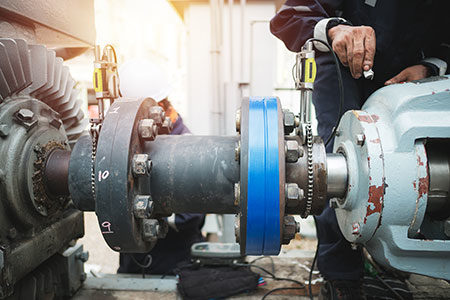
- Shaft alignment verified, since a pump and motor that drift out of alignment over time create excess vibration and premature bearing wear
- Seals and packing inspected for leakage, wear, or improper adjustment
- Coupling condition, including elastomer wear on flexible couplings
- Mounting bolts and baseplate integrity, since a loose foundation bolt can introduce vibration that mimics a much more serious internal problem
Vibration analysis Vibration is one of the earliest and most reliable indicators of developing mechanical trouble. Elevated vibration can point to imbalance, misalignment, bearing wear, cavitation, looseness, or resonance. Tracking vibration readings over successive inspections — rather than looking at a single snapshot — lets a technician see a trend developing well before it becomes audible or visible.
Thermal imaging Infrared thermography identifies hot spots that indicate friction, electrical resistance, or lubrication failure. A motor terminal running hotter than its neighbors, or a bearing housing trending upward inspection over inspection, often shows up on a thermal scan before it shows up anywhere else.
Laser alignment Shaft misalignment is one of the most common — and most preventable — causes of premature pump and motor failure. Laser alignment tools measure angular and parallel offset far more precisely than a straightedge or dial indicator, allowing technicians to correct alignment to tolerances that meaningfully extend bearing and seal life.
Electrical checks Motor amperage, insulation resistance, and control panel condition are reviewed to catch developing electrical issues before they cause a trip or a burnout.
Hydraulic performance Flow rate, discharge pressure, and suction conditions are compared against the pump’s original performance curve. A pump that’s drifted noticeably off its curve may be dealing with impeller wear, internal recirculation, or a system-side problem like a partially closed valve or a clogged strainer.
Building the Right Maintenance Schedule
Not every pump needs the same attention. A booster pump feeding a hospital or a fire suppression system carries a very different risk profile than a seasonal irrigation pump. Effective PM programs are built around criticality, run hours, and environment rather than a single blanket interval. Typical scheduling tiers include:
- Monthly inspections for critical, high-run-hour, or hard-to-access equipment where early detection has the biggest payoff
- Quarterly inspections for standard production or facility pumps operating under normal conditions
- Bi-yearly inspections for moderate-duty equipment with a stable operating history
- Annual inspections for standby, backup, or low-duty-cycle pumps
The right cadence also depends on the operating environment. Pumps handling abrasive or corrosive fluids, running at high temperatures, or operating in dusty or humid conditions typically need more frequent attention than clean-water applications in a controlled mechanical room.
The Value of Trend Data
A single inspection report tells you the condition of a pump on one particular day. A history of inspection reports tells you where that pump is headed. This is the real value of a documented PM program: each report should be compared against the ones before it, so a facility manager can see a bearing temperature climbing two or three degrees per quarter, or vibration readings edging upward on a predictable slope.
That kind of trend visibility changes the nature of maintenance decisions entirely. Instead of reacting to a failure, a facility can schedule a bearing replacement during a planned outage, budget for it in advance, and avoid the compounding damage that comes from running a failing component to the point of collapse. Well-organized reporting — with consistent measurement points and a clear comparison to prior visits — turns routine inspections into a genuine predictive maintenance tool rather than a box-checking exercise.
Common Failure Modes PM Programs Catch Early
Certain failure patterns show up again and again in pump systems, and most of them are detectable well in advance:
- Cavitation — caused by insufficient suction pressure, often from a clogged strainer, closed valve, or undersized suction piping. Left unaddressed, cavitation pits impellers and volutes, eventually destroying the pump internals.
- Bearing wear — usually driven by misalignment, imbalance, contamination, or inadequate lubrication. Vibration analysis and thermal imaging both flag this early.
- Seal failure — mechanical seals wear gradually; small leaks that go unnoticed can escalate into major leakage or dry-running damage.
- Impeller wear or damage — abrasive fluids or cavitation erode impeller vanes over time, showing up as a gradual drop in flow and head that a performance-curve comparison will reveal.
- Electrical degradation — insulation breakdown, loose connections, or phase imbalance can be caught with routine electrical testing before they cause a motor failure.
- Foundation and alignment drift — thermal cycling, settling, and vibration over time can shift a pump’s alignment even if it was installed correctly, which is why periodic laser alignment checks matter even on equipment that hasn’t been touched.
Building a Program That Fits Your Operation
A good PM program isn’t a generic checklist applied uniformly across every asset. It should reflect:
- Criticality — what happens operationally, financially, and safety-wise if this specific pump fails
- Duty cycle — continuous-duty pumps generally need more frequent attention than standby units
- Fluid and environment — abrasive, corrosive, or high-temperature service accelerates wear and shortens safe inspection intervals
- Asset age and history — older equipment or units with a history of problems warrant closer monitoring
- Regulatory and insurance requirements — some facilities, particularly municipal water systems and fire protection systems, have inspection obligations that shape the schedule
Getting this right typically means starting with manufacturer-recommended maintenance intervals, then adjusting based on the equipment’s actual operating history and criticality ranking within the facility.
The Bottom Line
Preventive maintenance is ultimately a bet that a small, predictable cost today is cheaper than a large, unpredictable cost tomorrow — and it’s a bet that wins consistently when it’s backed by good data. Routine inspections, vibration testing, thermal imaging, and laser alignment aren’t ends in themselves; they’re the inputs that let trend reports do their job. A facility that tracks bearing temperature, vibration, and alignment inspection over inspection isn’t just maintaining equipment — it’s building a record that tells it exactly when to intervene, long before a pump ever announces its problems the hard way.
For any facility running critical water infrastructure, the math favors a documented, criticality-based inspection schedule over waiting for something to break. The upfront cost of routine service is consistently smaller than the cost of emergency repair, secondary damage, and downtime — and it’s the difference between planning a repair and reacting to a failure.
Contact our team to learn more about our industrial pump services!